- Date
- Time
- 5 pm
- Venue
- Studio at The Muses, 58 Waterside, Stratford-upon-Avon, Warwickshire
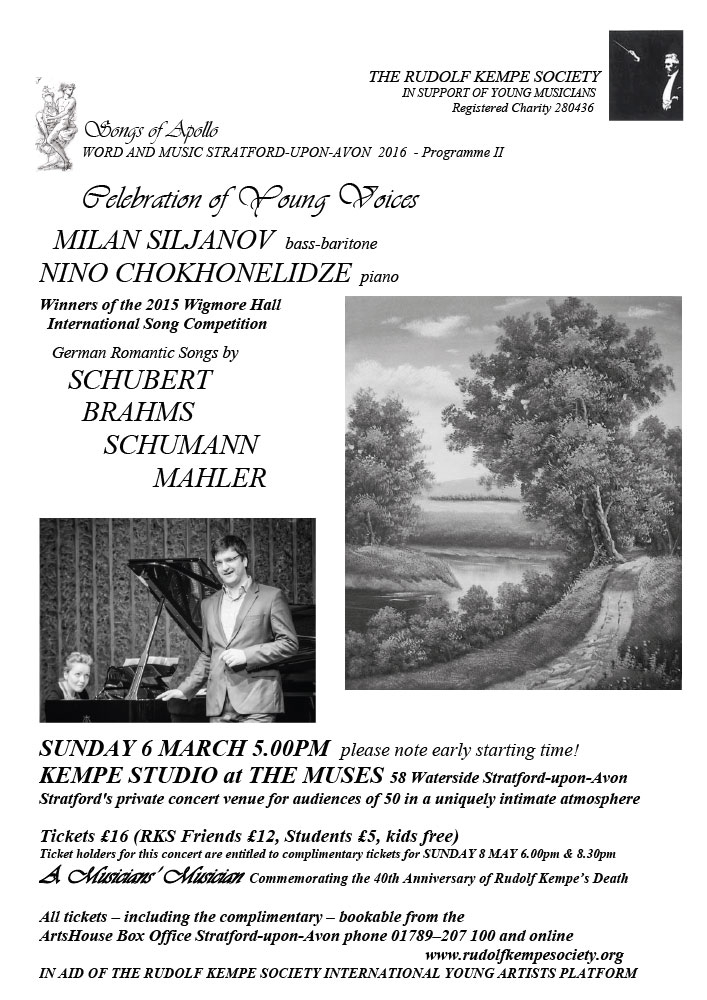
Lieder of the German Romantics – a Celebration of Young Voices and Programme II of the Rudolf Kempe Society’s 2016 Songs of Apollo season – presented the bass-baritone Milan Siljanov, winner of the 2015 Wigmore Hall / Kohn Foundation International Song Competition, in songs by Schubert, Brahms, Schumann and Mahler that he chose and compiled himself. It took place on Sunday 6 March 2016 at 5.00 pm at the Kempe Studio at The Muses, 58 Waterside, Stratford-upon-Avon, in aid of the Rudolf Kempe Society International Young Artists Platform.
The concert was advertised with Milan Siljanov’s wife and duo partner, the pianist Nino Chokhonelidze, who had won the Wigmore Hall competition with him; she had to withdraw after injuring her arm, and the pianist Jonathan Ware stepped in at short notice. In her welcome, the Patron Dame Judi Dench likened these song evenings to the Schubertiads of the 19th century.
Performers
- Milan Siljanov – bass-baritone. On the Opera Course at the Guildhall School of Music & Drama with Rudolf Piernay, he won the 2015 Wigmore Hall / Kohn Foundation International Song Competition and, in 2014, first prize and audience prize at the 50th International Vocal Competition in ’s-Hertogenbosch. A Samling Artist and Independent Opera Voice Fellow, he was about to join the Young Artists Programme of the Bavarian State Opera in Munich.
- Jonathan Ware – piano. Born in Texas and trained at the Eastman School, the Juilliard School and the Hanns Eisler Hochschule in Berlin, where he went on to teach, he won the Pianist’s Prize at the Wigmore Hall and Das Lied competitions and first prize at the International Hugo Wolf Competition in Stuttgart, and partnered singers such as Dame Felicity Lott and Benjamin Appl.
- Billed: Nino Chokhonelidze – piano (withdrew through injury).
Programme
Part I
Franz Schubert – selected songs
- Prometheus (Goethe)
- Gruppe aus dem Tartarus (Schiller)
- Der Wanderer an den Mond (Seidel)
- Aufenthalt (Rellstab)
- Schäfers Klagelied (Goethe)
- Meeres Stille (Goethe)
- Auf der Bruck (Ernst Schulze)
Johannes Brahms – Vier ernste Gesänge (Four Serious Songs), Op. 121, on words from Luther’s Bible
- Denn es gehet dem Menschen (Ecclesiastes 3:19–22)
- Ich wandte mich (Ecclesiastes 4:1–3)
- O Tod, wie bitter bist du (Ecclesiasticus 41:1–2)
- Wenn ich mit Menschen- und mit Engelszungen redete (1 Corinthians 13:1–3, 12–13)
Interval
Part II
Robert Schumann – selected songs
- Tragödie I: “Entflieh mit mir und sei mein Weib” (Heine)
- Tragödie II: “Es fiel ein Reif in der Frühlingsnacht” (Heine)
- Mein Wagen rollet langsam (Heine)
- Die Löwenbraut (Chamisso)
Gustav Mahler – from Des Knaben Wunderhorn (anonymous folk poetry)
- Der Tamboursg’sell
- Lob des hohen Verstandes
- Des Antonius von Padua Fischpredigt
About the programme
Cordula Kempe’s introduction, German Romantic Songs, argued that Romanticism – love of nature and human love at its heart – was no retreat into an ivory tower: artists, more sensitive and so more vulnerable than most, open an inner world of spirit that can heal, and access to it is everyone’s birthright. The programme, she wrote, ranged across “love – loss – grief – joy – horror – compassion – and even sense of humour”.
Her notes on each composer traced Schubert’s songs from Goethe’s defiant Prometheus to Schiller’s vision of the damned in Hades; Brahms’s Four Serious Songs, finished on his last birthday in 1896 as Clara Schumann lay dying, moving from death and oppression to St Paul’s faith, hope and charity; Schumann’s songs from 1840–41, the years of his marriage to Clara; and Mahler’s Wunderhorn settings, which run “from utter poignancy to irony and great sense of humour”.
The duo returned to the Society in April 2017, and Milan Siljanov sang Mahler and Schubert in its Dresden commemoration of Rudolf Kempe in May 2016.
Credits
- Programme chosen and compiled by Milan Siljanov; introduction and notes by Cordula Kempe
- Patron: Dame Judi Dench
- Publicity and printing: Max Ross
Downloads
- Poster (PDF) PDF
The Rudolf Kempe Society closed in 2021. This page is kept as a record of a past event.