- Date
- Time
- 7.30 pm
- Venue
- Studio at The Muses, 58 Waterside, Stratford-upon-Avon, Warwickshire
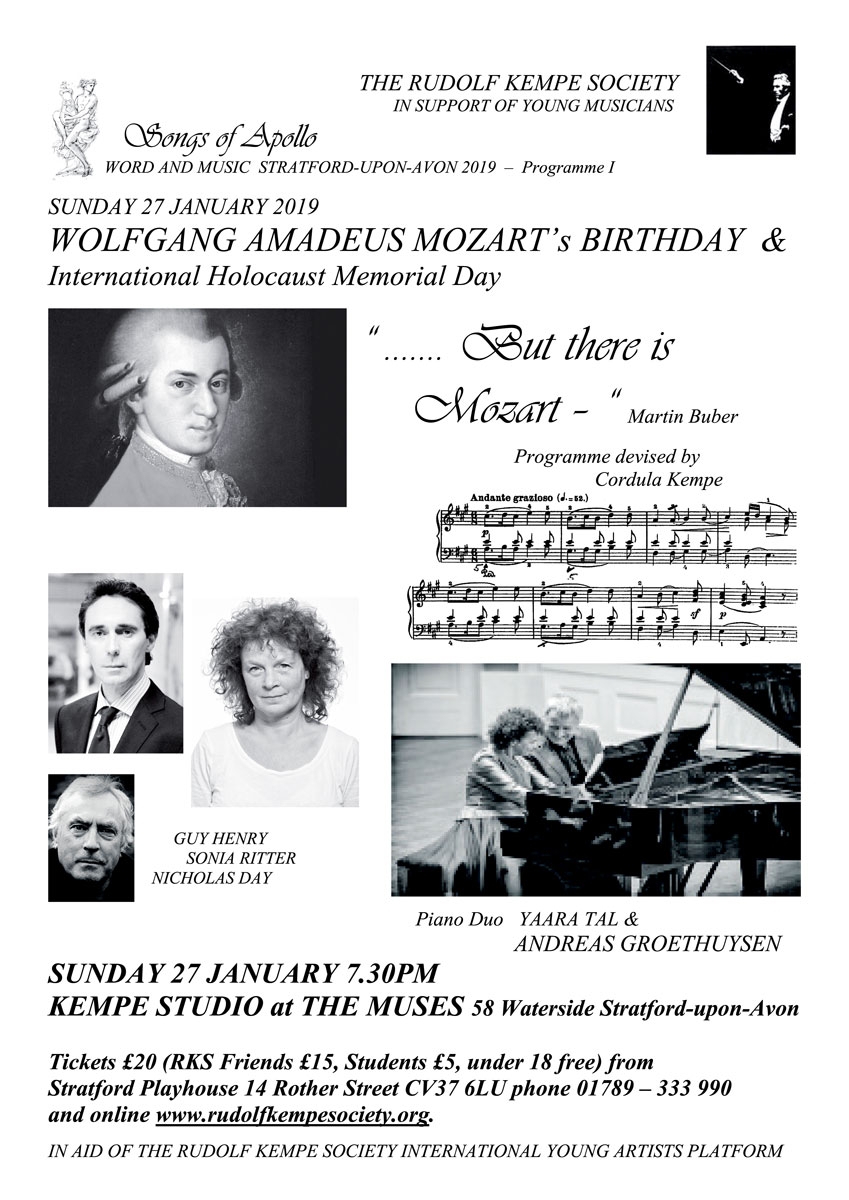
“… But there is Mozart” opened the Rudolf Kempe Society’s 2019 Songs of Apollo Word and Music season at Stratford-upon-Avon as Programme I. Devised by Cordula Kempe, it commemorated two dates that fall on the same day – International Holocaust Remembrance Day and Wolfgang Amadeus Mozart’s birthday (1756) – in poetry and prose by Jewish and non-Jewish poets and writers of many cultures and periods, with music by Mozart, Franz Xaver Mozart, Julie von Webenau, Mendelssohn and Beethoven. It took its title from words of the philosopher Martin Buber, and was performed on Sunday 27 January 2019 at 7.30 pm at the Kempe Studio at The Muses, 58 Waterside, Stratford-upon-Avon, in aid of the Rudolf Kempe Society International Young Artists Platform.
Performers
- Guy Henry – actor. Trained at RADA; with the Royal Shakespeare Company he played the title role in King John, Malvolio, Dr Caius, Cloten and Sir Andrew Aguecheek, and on screen he is known for Rome, John Adams, several Harry Potter films and the BBC’s Holby City.
- Sonia Ritter – actor. Trained at the Bristol Old Vic, she had worked for nearly thirty years with the RSC, BBC television and radio and in repertory and touring theatre; she also directs (Lilies on the Land, West End and tour), runs two annual London street festivals, sings alto and lectures in performance.
- Nicholas Day – actor. Known as DS Michael Morley in Minder and from New Tricks, The Golden Bowl, Amazing Grace and The Wolfman, he spent seven seasons with the RSC and wrote the book On Bard Duty about that time.
- Yaara Tal and Andreas Groethuysen – piano duo. One of the world’s leading piano duos, heard at the Concertgebouw, the Berlin Philharmonie, La Scala, the Salzburg and Lucerne festivals and the Vienna Musikverein. Their many Sony Classical recordings – including first recordings of four-hand music by Czerny, Mendelssohn, Reger and Wagner, and the complete Schubert four-hand works and Mozart piano duos – have won nine German Record Critics’ Awards and five Echo Klassik prizes. They have taught piano duo at the Munich Academy and, since 2014, at the Mozarteum in Salzburg.
Programme
Readers: Guy Henry (GH), Sonia Ritter (SR), Nicholas Day (ND), or the whole ensemble. Music by Yaara Tal and Andreas Groethuysen. Editorial links and history introductions by Cordula Kempe ran through the evening.
Part I
- W. A. Mozart – Fugue in G minor, K 401, for four hands
- W. A. Mozart – Sonata in A major, K 331: Andante grazioso, theme (the evening’s recurring “theme tune”)
- Holocaust Remembrance Day: Joshua Sobol, The Task of Art (ND); Anonymous, Another Task of Art (SR); Elizabeth Daryush, We Should at Times Go Out (GH); Hazell Hills, There Is a Time We Recognise (SR); Carl Sandburg, Choose (ND)
- Ludwig van Beethoven – Piano Sonata No. 32 in C minor, Op. 111: I. Maestoso – Allegro con brio ed appassionato
- History lesson – thoughts on Judaism by W. N. Ewer, C. Browne and Sagittarius; Erich Fried, Constructive Self-Criticism (ND); a historical note on Lilian Baylis (SR); Stevie Smith, Recognition Not Enough (GH); from the Book of Common Prayer (GH); Sholem Aleichem, Tevye the Milkman (ND)
- W. A. Mozart – Sonata in B flat major for four hands, K 358: I. Allegro
- John Dryden – from Absalom; Dan Pagis, Autobiography (GH); Yehuda Amichai, As for the Deeds (ND); D. J. Enright, Having the Last Word (SR); Anonymous (11th–12th century), The Poet’s Commandments to God (ND)
- W. A. Mozart – Sonata K 358: II. Adagio
- Old Testament – Blessed Is the Man
- Stevie Smith, God Speaks (SR); William Nicholson, from Shadowlands, Act I; D. J. Enright, Disciple
- G. F. Handel – from Messiah; D. J. Enright, Aria (SR)
- Anonymous (13th–14th century), A Dirge for the Ninth of Av (ND); Shaul Tchernichovsky, He’s Come!
- Franz Xaver Mozart – Polonaise in B minor, Op. 17 No. 1 (Yaara Tal)
- Zbigniew Herbert – Mr Cogito Tells about the Temptation of Spinoza (SR, GH)
- Shakespeare, Edward Young and William Blake – thoughts on mercy
- Osip Mandelstam – Alexander Herzovich (SR)
- Franz Schubert – from the Sonata in B flat major, D 960
- Osip Mandelstam, In the Haze (ND); Yehuda Amichai, When You Smile (GH); Leonard Cohen, The Dream
- W. A. Mozart – Sonata K 358: III. Molto presto
- Allen Ginsberg, I Made Love; Rabbi Hillel, If Not Now – When? (GH)
- Julie von Webenau – L’Adieu, Op. 25 No. 1: Moderato (Yaara Tal)
- Bertolt Brecht, The Burning of the Books (GH); Anna Świrszczyńska, He Was Lucky (ND); Fleur Adcock, Loving Hitler (SR)
- Klezmer – Hava Nagila
- Dan Pagis and Jerzy Ficowski, Scrawled in Pencil; Dan Pagis, Testimony (GH); Bertolt Brecht, Dark Times
- Mozart’s words; Anonymous, Prayer from a Concentration Camp (ND)
Interval
Part II
- Julie von Webenau – Le Retour, Op. 25 No. 2: Allegretto (Yaara Tal)
- Gotthold Ephraim Lessing – scenes from Nathan the Wise: Sittah (SR), the Templar (GH), Nathan (ND), Recha (SR)
- Franz Xaver Mozart – Polonaise in F minor, Op. 12 No. 5 (Yaara Tal)
- Gotthold Ephraim Lessing – the Ring Parable (GH, ND)
- Felix Mendelssohn – Octet in E flat major, Op. 20, arranged for four hands: I. Allegro moderato ma con fuoco
- Holocaust afterthoughts by poets of today: Lily Brett, Leaving You and Her Mother’s Reply (SR); Hazell Hills, Unentitled (GH); Erich Fried, Hear Ye Israel (ND); Leonard Cohen, Israel (GH); Czesław Miłosz, Practical Advice
- St Paul, 1 Corinthians 13 (with George Orwell); the Talmud, At the Advent of the Messiah; Yehuda Amichai, Sort of an Apocalypse
- Mozart’s words (GH); Martin Buber, Power and Love (SR)
- Ludwig van Beethoven – Piano Sonata No. 32 in C minor, Op. 111: II. Arietta – Adagio molto semplice e cantabile (Andreas Groethuysen)
About the programme
Dame Judi Dench’s welcome called the two themes “seemingly opposed”, but complementing each other “contrapunctually as it were”. The booklet opened with Marc Chagall’s White Crucifixion (1938), in which Jesus is shown as a Jewish martyr, and Yad Vashem, “the 20th-century crown of thorns”, and printed Cordula Kempe’s translation of Martin Buber’s late poem Power and Love (1964).
Its notes introduced the writers and composers: Martin Buber (1878–1965), the Viennese religious philosopher of I and Thou, who argued for a binational state shared with the Palestinians and translated the Bible into German with Franz Rosenzweig; Gotthold Ephraim Lessing, whose Nathan the Wise (1779), a plea for tolerance between Judaism, Christianity and Islam built around the Ring Parable, was banned in his lifetime and again by the Nazis, and was the first play performed in Germany after the war – its Nathan modelled on the philosopher Moses Mendelssohn, the composer’s grandfather; Franz Xaver Mozart (1791–1844), Mozart’s youngest surviving son, composer and teacher; and his pupil Julie von Webenau (1813–1887), to whom Schumann dedicated his Humoreske. The Beethoven pages noted that his last piano sonata, Op. 111, was published in 1823, the year of Waldmüller’s portrait.
The programme was later released as a film – see Online Concert.
Press
Dr Richard Pearce reviewed the concert in the Stratford Herald under the headline “Power and love”: “words and music drew the audience into an unforgettable and truly sublime experience”. The review is shown on the Online Concert page.
Credits
- Devised, and the programme booklet written, compiled and designed, by Cordula Kempe
- Publicity, printing and archive recording: Max Ross
- Dame Judi Dench, Patron; Richard Pearce, Chairman of the Society
Downloads
- Poster (PDF) PDF
The Rudolf Kempe Society closed in 2021. This page is kept as a record of a past event.