- Date
- Time
- 7.30 pm
- Venue
- Studio at The Muses, 58 Waterside, Stratford-upon-Avon, Warwickshire
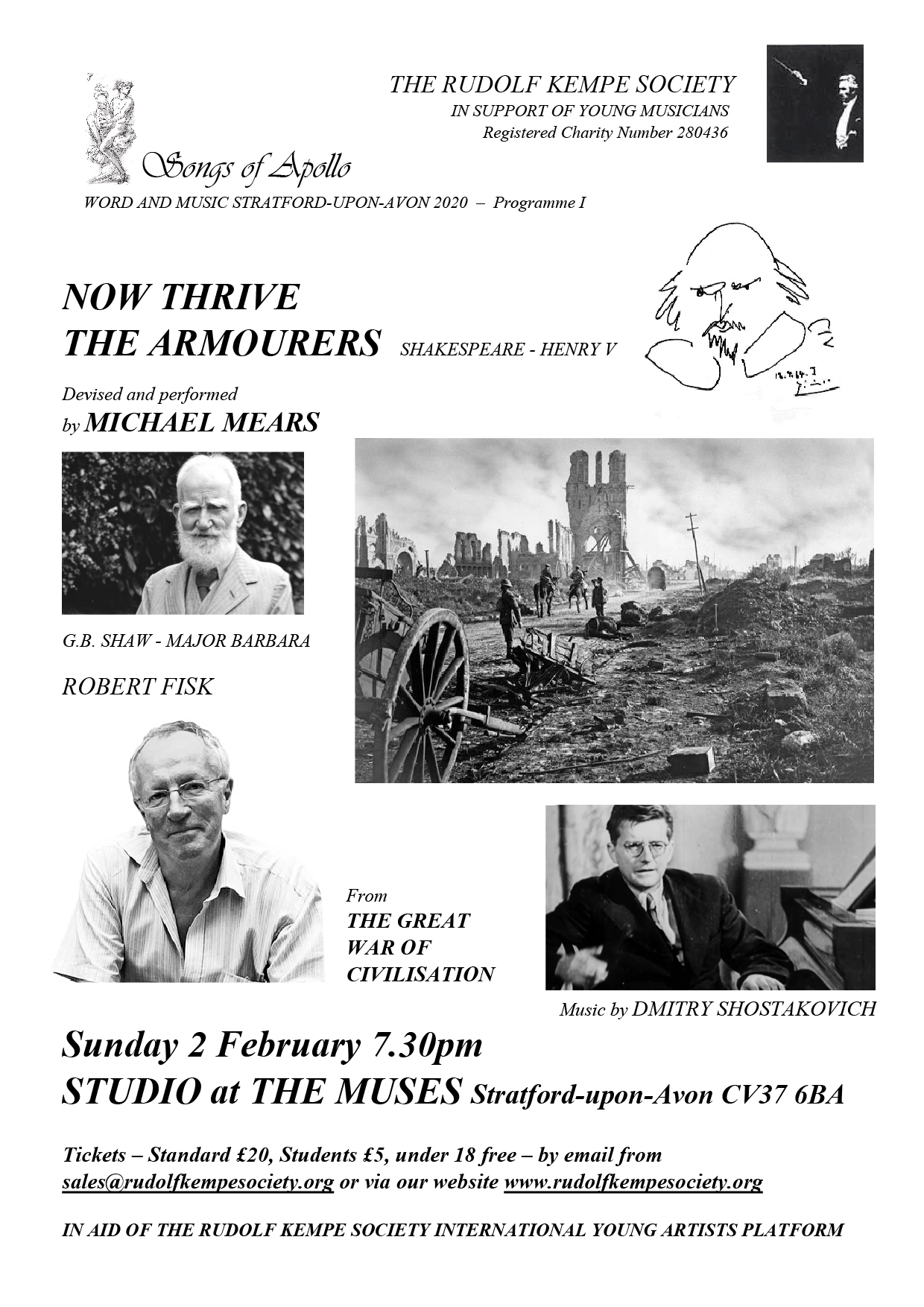
Now Thrive the Armourers opened the Rudolf Kempe Society’s 2020 Songs of Apollo Word and Music season at Stratford-upon-Avon – its 40th anniversary season – as Programme I. Compiled and read by the actor Michael Mears, it set readings from Shakespeare’s King Henry V, George Bernard Shaw’s Major Barbara and Robert Fisk’s The Great War for Civilisation beside recorded music by Dmitri Shostakovich, played by the composer himself and by the young piano duo Jakob Fichert (an RKS alumnus) and Vicky Yannoula. It took place on Sunday 2 February 2020 at 7.30 pm at the Kempe Studio at The Muses, 58 Waterside, Stratford-upon-Avon, in aid of the Rudolf Kempe Society International Young Artists Platform. Robert Fisk gave his permission for the reading from his book.
Performers
- Michael Mears – compiler and reader. An actor for over three decades in theatre, radio, film and television, with the National Theatre, the Royal Shakespeare Company, the Peter Hall Company and in the West End. He had written three solo stage plays and seven solo plays for BBC Radio 4, all performed by himself; Soup, about homelessness, won a Scotsman Fringe First at Edinburgh, and This Evil Thing, about Britain’s First World War conscientious objectors, had been given more than 100 times in the UK – including at the Kempe Studio in 2017 – and at 17 venues in the USA.
Recorded music
- Dmitri Shostakovich (piano) with the Beethoven Quartet – Piano Quintet in G minor, Op. 57, in their 1940 recording
- Jakob Fichert and Vicky Yannoula – piano duo; all the other Shostakovich pieces
Programme
Part I
- Shakespeare – Henry V, Act I, Prologue: “O for a muse of fire”
- Shostakovich – Piano Quintet in G minor, Op. 57: Prelude (Lento – Poco più mosso – Lento)
- Shakespeare – Henry V, Act I, scene 2: “What treasure, uncle?”; Act II, Chorus (extract): “Now all the youth of England are on fire”
- Shostakovich – Piano Quintet, Op. 57: III. Scherzo (Allegretto)
- George Bernard Shaw – Major Barbara, Act I: “Here I am, a manufacturer of mutilation and murder”
- Shostakovich – Merry March, Op. 84c
- George Bernard Shaw – Major Barbara, Act III: “But Mr Undershaft, what about the moral question?”
- Shostakovich – Ballet Suite No. 2, Op. 89b: No. 3, Polka
- Shakespeare – Henry V, Act III, Chorus: “Thus with imagined wing”; Act III, scene 1: “Once more unto the breach, dear friends”
- Shostakovich – Korzinkina’s Adventures, Op. 59 No. 3: The Chase
- Shakespeare – Henry V, Act IV, Chorus: “Now entertain conjecture of a time”
- Shostakovich – Piano Quintet, Op. 57: IV. Intermezzo (Lento)
- Shakespeare – Henry V, Act IV, scene 8: “Now, herald, are the dead number’d?”
- Shostakovich – Piano Quintet, Op. 57: V. Finale (Allegretto)
Interval
Part II
- Robert Fisk – from The Great War for Civilisation, the chapter “Now Thrive the Armourers”
- Shostakovich – Piano Quintet, Op. 57: quotation from II. Fugue (Adagio)
- Robert Fisk – The Great War for Civilisation (continued)
- Shostakovich – Piano Quintet, Op. 57: II. Fugue
- Shakespeare – Henry V, Act V, scene 2: “My duty to you both, on equal love”
- Shostakovich – Unity, Op. 95d: Waltz
- The composer on his music
About the programme
The title comes from the Chorus of Henry V: “Now all the youth of England are on fire … Now thrive the armourers”. In her introduction Cordula Kempe called the line more topical than ever – from Thucydides to the daily news – and asked why mankind keeps seeking “the bubble reputation even in the cannon’s mouth”: out of envy, greed or lust for power, while resources that could feed the needy are spent on war. She objected to the phrase “innocent civilians”, asking whether soldiers, often poor young men with no other prospects, are not human beings too, recalled Gandhi’s resolve that he would “rather be killed than kill”, and offered as a counterpoint Martin Buber’s poem Power and Love in her own translation. Dame Judi Dench’s welcome described a programme “somewhat off the beaten track – difficult but fascinating”.
The booklet’s notes explained the sources: Shaw’s Major Barbara (1905), in which a Salvation Army major confronts her father, a rich arms manufacturer; Robert Fisk, The Independent’s multi-award-winning Middle East correspondent in Beirut for more than 40 years, from whose book the chapter “Now Thrive the Armourers” was taken; and Henry V itself, illustrated with Henry Fuseli’s painting for the Boydell Shakespeare Gallery of the king before setting out for France – a war that, unusually, ends in a marriage linking two nations in peace.
Credits
- Compiled and read by Michael Mears; reading from The Great War for Civilisation by kind permission of Robert Fisk
- Programme booklet compiled and designed by Cordula Kempe
- Publicity, printing and archive recording: Max Ross
- Dame Judi Dench, Patron; Richard Pearce, Chairman of the Society
Downloads
- Poster (PDF) PDF
The Rudolf Kempe Society closed in 2021. This page is kept as a record of a past event.