- Date
- Time
- 7.30 pm
- Venue
- Studio at The Muses, 58 Waterside, Stratford-upon-Avon, Warwickshire
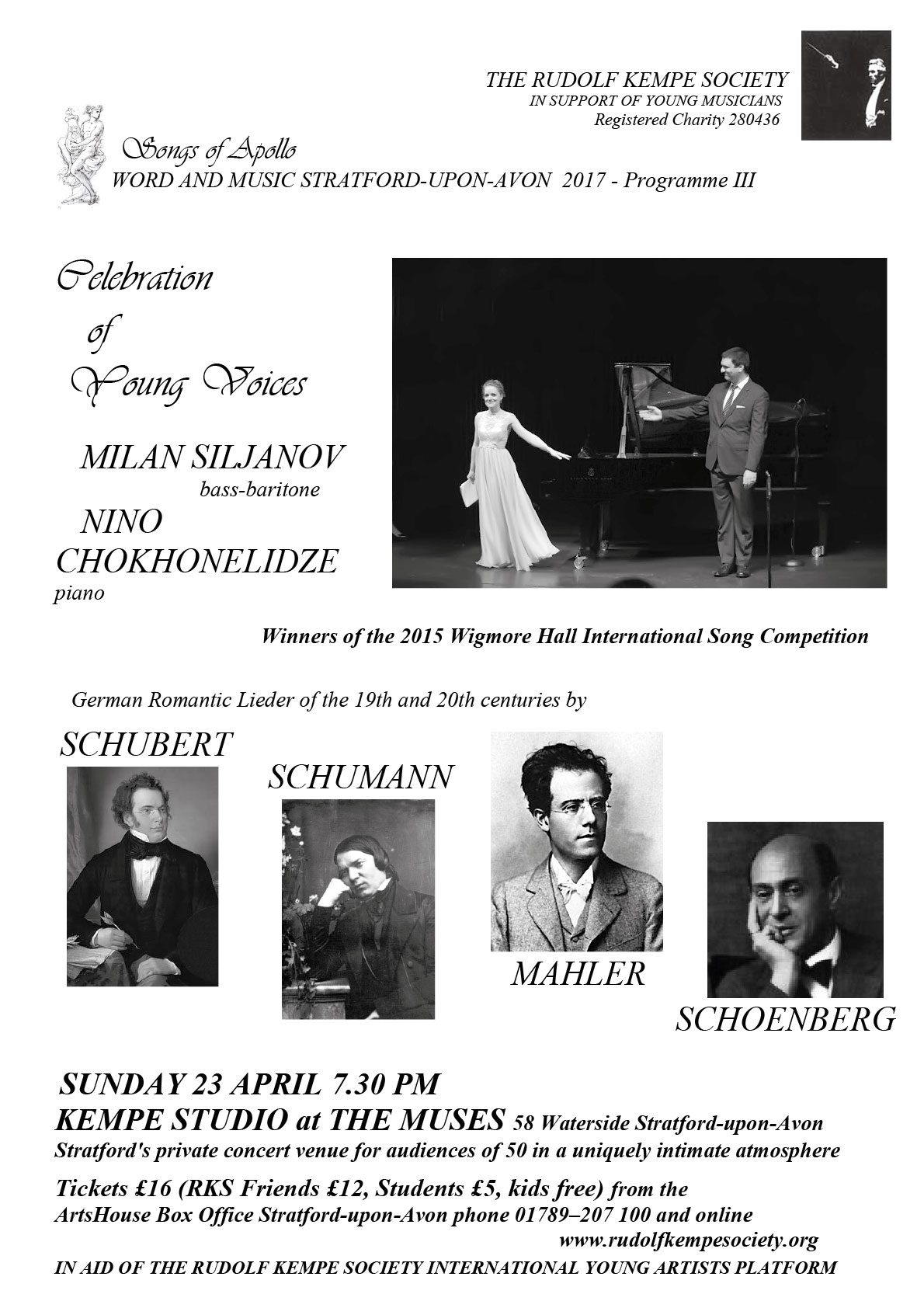
This Celebration of Young Voices recital, Lieder of the German Romantics, was Programme III of the Rudolf Kempe Society’s 2017 Songs of Apollo season. The bass-baritone Milan Siljanov and the pianist Nino Chokhonelidze – winners of the 2015 Wigmore Hall/Kohn Foundation International Song Competition – returned to Stratford with songs by Schubert, Mahler, Schumann and the young Schoenberg, in a programme chosen by Milan Siljanov. It took place on Sunday 23 April 2017 – St George’s Day and Shakespeare’s birthday – at 7.30 pm at the Kempe Studio at The Muses, 58 Waterside, Stratford-upon-Avon, a few days before the duo’s appearance on BBC Radio 3’s In Tune (26 April) and their Wigmore Hall recital in London (27 April). It was given in aid of the Rudolf Kempe Society International Young Artists Platform.
Performers
- Milan Siljanov – bass-baritone. A member of the Young Artist Programme of the Bavarian State Opera and a Samling Artist, he trained on the Guildhall School’s opera course with Rudolf Piernay. He won the 2015 Wigmore Hall/Kohn Foundation International Song Competition, first and audience prizes at the 50th International Vocal Competition in ’s-Hertogenbosch (2014), and the Verbier Festival Academy’s Prix Yves Paternot, where he sang Leporello; roles in Munich were to include parts in La Bohème, Tannhäuser and Ariadne auf Naxos.
- Nino Chokhonelidze – piano. Born in Tbilisi, she studied at the Tbilisi State Conservatory and the Zurich University of the Arts. She won the Pianist’s Prize at the 2015 Wigmore Hall/Kohn Foundation Song Competition, first and audience prizes in ’s-Hertogenbosch (2014) and the Pianist’s Prize at the International Schubert Competition for Lied in Dortmund (2013), and had worked in master classes with Thomas Hampson, Thomas Quasthoff, Christa Ludwig, Elly Ameling and Helmut Deutsch, among others.
Programme
Part I
Franz Schubert – selected songs
- Der Einsame, D 800 (Karl Lappe)
- Gruppe aus dem Tartarus, D 583 (Friedrich von Schiller)
- Der Wanderer an den Mond, D 870 (Johann Gabriel Seidl; printed in the booklet as D 87)
- From Schwanengesang, D 957: Aufenthalt (Ludwig Rellstab) and Der Doppelgänger (Heinrich Heine)
- Schäfers Klagelied, D 121 (Johann Wolfgang von Goethe)
- Auf der Bruck, D 853 (Ernst Schulze)
Gustav Mahler – from Des Knaben Wunderhorn
- Des Antonius von Padua Fischpredigt
- Rheinlegendchen
- Lob des hohen Verstandes
– Interval –
Part II
Robert Schumann – selected songs
- Tragödie I, “Entflieh mit mir und sei mein Weib”, Op. 64 No. 3 (Heinrich Heine)
- Tragödie II, “Es fiel ein Reif in der Frühlingsnacht”, Op. 64 No. 3 (Heinrich Heine)
- Der Schatzgräber, Op. 45 No. 1 (Joseph von Eichendorff)
- Mein Wagen rollet langsam, Op. 142 No. 4 (Heinrich Heine)
- Der Nussbaum, Op. 25 (Julius Mosen)
- Die Löwenbraut, Op. 31 No. 1 (Adalbert von Chamisso)
Arnold Schoenberg – three early songs
- Warum bist du aufgewacht?, from Nachtblumen (Ludwig Pfau)
- Warnung, Op. 3 No. 3 (Richard Dehmel)
- Dank, Op. 1 No. 1 (Karl von Levetzow)
About the programme
Cordula Kempe’s introduction described the evening as a continuation of the Society’s celebration of Lieder and of young artists, this time reaching into the early 20th century with songs by Schoenberg – “but they are still highly romantic”. She argued that Romanticism was not a retreat into an ivory tower but an inner, spiritual world that helps people face reality, and that the composers and poets of the programme spanned love, loss, grief, joy, horror, compassion and humour. Her note on the duo marvelled at the range of a single programme – from the serenity of Schubert’s Der Einsame to the drama of Schumann’s Die Löwenbraut, from the chill of Der Doppelgänger to the irony of Mahler’s Wunderhorn songs – and at the versatility of two artists still in their twenties.
The booklet’s composer notes traced Schubert’s hundreds of Lieder and quoted his letter of 3 July 1822: “I wanted to sing of love, but it turned into pain.” Schumann’s songs in the programme date from his great Lieder years of 1840–41, the time of his marriage to Clara Wieck; Mahler’s come from the folk-poetry collection Des Knaben Wunderhorn (1805) of Achim von Arnim and Clemens Brentano. The note on Schoenberg reminded listeners that before serialism he was steeped in Brahms and late Romanticism – as in Verklärte Nacht, also inspired by a poem by Dehmel. The booklet was illustrated with drawings by Moritz von Schwind, Schubert’s friend, and landscapes by Caspar David Friedrich, and opened with a welcome from Dame Judi Dench.
Credits
- Programme chosen and compiled by Milan Siljanov
- Programme booklet written and designed by Cordula Kempe
- Welcome: Dame Judi Dench, Patron of the Rudolf Kempe Society
- Publicity, printing and archive recordings: Max Ross
Downloads
- Poster (PDF) PDF
The Rudolf Kempe Society closed in 2021. This page is kept as a record of a past event.