- Date
- Time
- 7.30 pm
- Venue
- Studio at The Muses, 58 Waterside, Stratford-upon-Avon, Warwickshire
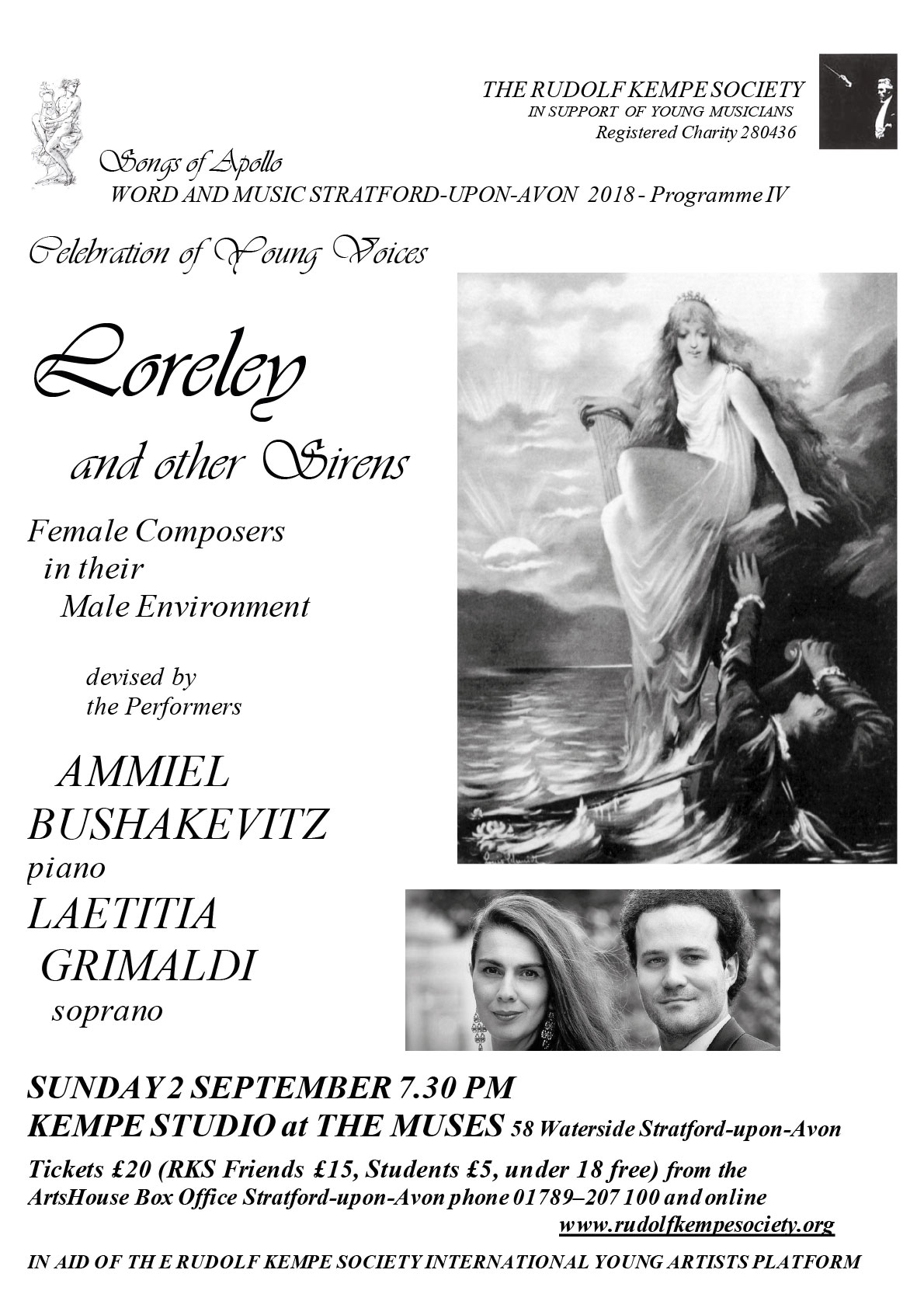
Loreley and other Sirens – Female Composers in their Male Environment was Programme IV of the Rudolf Kempe Society’s 2018 Songs of Apollo Word and Music season at Stratford-upon-Avon, part of its Celebration of Young Voices. Devised by the performers themselves – the soprano Laetitia Grimaldi and the pianist Ammiel Bushakevitz, a multi-award-winning duo – it brought together piano music and Lieder by male and female composers of the 19th and early 20th centuries. It took place on Sunday 2 September 2018 at 7.30 pm at the Kempe Studio at The Muses, 58 Waterside, Stratford-upon-Avon, in aid of the Rudolf Kempe Society International Young Artists Platform.
Performers
- Laetitia Grimaldi – lyric soprano. Born in France and brought up in Lisbon and London, she began her vocal studies with Teresa Berganza and graduated from the Juilliard School in New York. Since her Carnegie Hall debut in 2013 she has sung at the Verbier, Aix-en-Provence and Ravinia festivals – including Musetta in La Bohème at Verbier in 2015 – and in 2017 won first prizes at the Concours International Robert Massard in Bordeaux and the Concours International de Mélodies Françaises in Montreal. (Billed in 2014 as Laetitia Spitzer-Grimaldi.)
- Ammiel Bushakevitz – piano. Born in Jerusalem and raised in South Africa, he studied at the Leipzig Hochschule für Musik und Theater and the Paris Conservatoire, and is a prize-winner of the Wigmore Hall Song Competition, the International Schubert Competition in Stuttgart and the International Brahms Competition. He has played at the Salzburg, Bayreuth and Lucerne festivals, made eight recordings for labels including BIS and Hänssler Classics, mentors young musicians in developing countries, and was named an Edison Fellow of the British Library in 2014.
Programme
The booklet does not print a running order; it introduces the composers and poets of the evening:
- Poems of the Loreley – Heinrich Heine’s Die Lorelei (set by Liszt and Clara Schumann) and Josef von Eichendorff’s Waldesgespräch (“A Forest Dialogue”), printed in German and English
- Clara Schumann (1819–1896) and Robert Schumann (1810–1856)
- Fanny Mendelssohn (1805–1847) and Felix Mendelssohn (1809–1847)
- Franz Liszt
- Ethel Smyth (1858–1944)
- Amy Beach (1867–1944)
- Cécile Chaminade (1857–1944)
About the programme
In her introduction Cordula Kempe explained the title: the myth of the siren Loreley, in the poems of Heine and Eichendorff set by many Romantic composers, stood for the way gifted women were cast as “sirens” and kept from public music-making – often by musicians in their own families – and forbidden to publish. Clara Schumann was allowed to perform because her concerts fed her family of eight children, while Fanny Mendelssohn, whose music could not be told apart from her brother’s, was not allowed by Felix to publish. Ethel Smyth joined the same Leipzig circle and became a champion of women’s rights; Amy Beach in America and Cécile Chaminade in France, not even admitted to the Conservatoire, fought all their lives for recognition. Her summary: “Food for thought – and a cornucopia of beautiful music.”
The booklet’s notes on the composers recall, among much else, that Amy Beach was the first American woman to write a symphony (the Gaelic, 1896) and first president of the Society of American Women Composers; that Ethel Smyth was imprisoned for two months as a suffragette and made a Dame in 1922; and that Chaminade was the first female composer to receive the Légion d’honneur (1913). Five of the evening’s musicians had studied, lived or worked in Leipzig. A postlude recalled that in 1961, newly appointed Principal Conductor of the Royal Philharmonic Orchestra, Rudolf Kempe introduced its first women members – who were “greeted with reserve”.
Dame Judi Dench welcomed the young artists to “a very fascinating, off the beaten track programme, on a theme particularly close to my own heart”.
Credits
- Devised by Laetitia Grimaldi and Ammiel Bushakevitz
- Programme booklet written and designed by Cordula Kempe
- Publicity, printing and archive recording: Max Ross
- Dame Judi Dench, Patron; Richard Pearce, Chairman of the Society
Downloads
- Poster (PDF) PDF
The Rudolf Kempe Society closed in 2021. This page is kept as a record of a past event.