- Date
- Time
- 5 pm
- Venue
- Studio at The Muses, 58 Waterside, Stratford-upon-Avon, Warwickshire
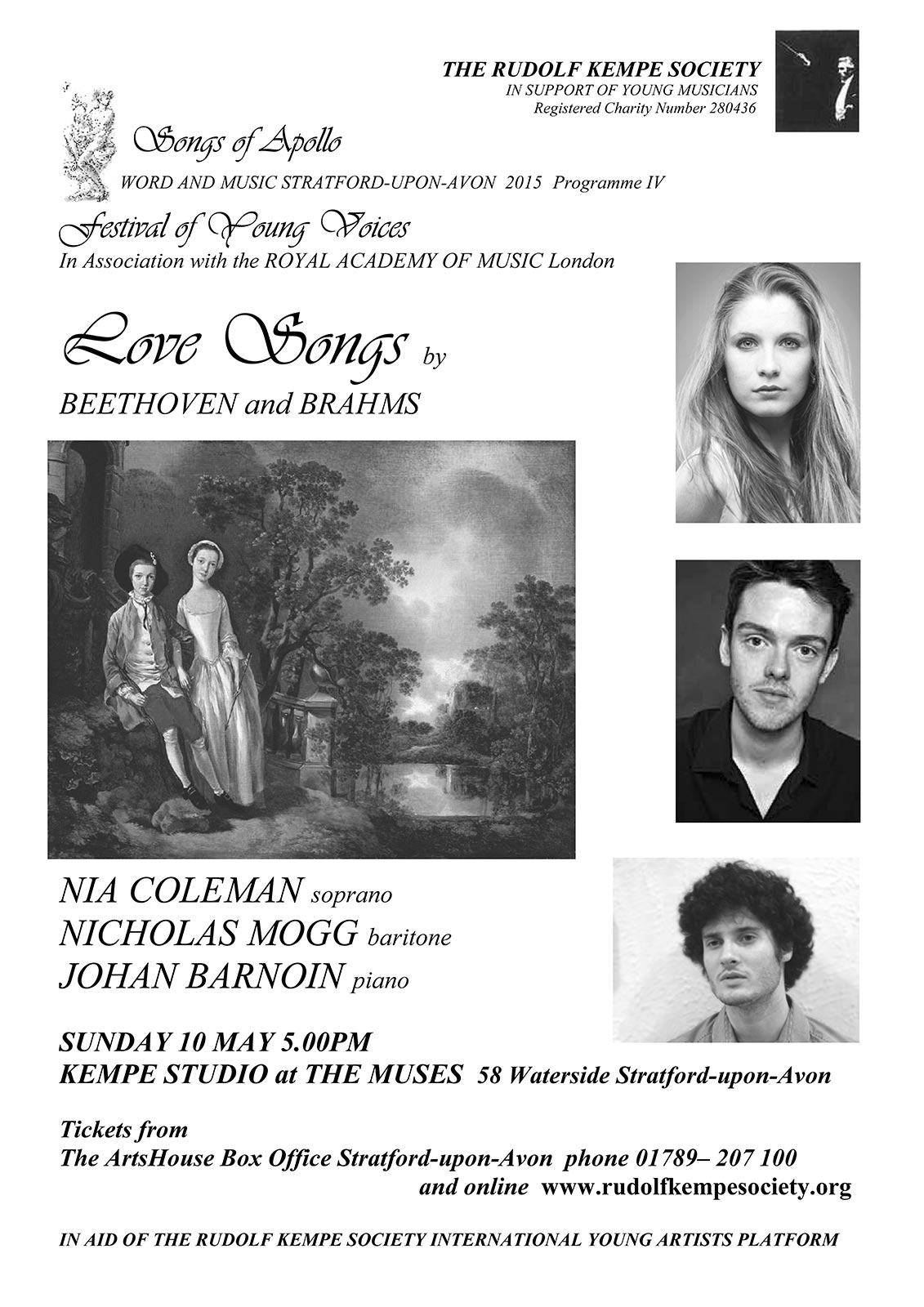
A Celebration of Love Songs by Beethoven and Brahms was Programme IV of the Rudolf Kempe Society’s 2015 Songs of Apollo season and part of its Festival of Young Voices, given in association with the Royal Academy of Music and Oxford Lieder. Three young artists of the RKS International Young Artists Platform 2015 – two singers and a pianist from the Academy – gave German folk-song settings by Brahms and Beethoven’s song cycle An die ferne Geliebte on Sunday 10 May 2015 at 5.00 pm at the Kempe Studio at The Muses, 58 Waterside, Stratford-upon-Avon. It was given in aid of the Rudolf Kempe Society International Young Artists Platform.
Performers
- Nia Coleman – soprano (RKS International Young Artists Platform 2015). Born in England and inspired by American musicals during a childhood in California, she graduated with a First in Music and Drama from the University of Manchester, twice winning its Procter-Gregg Prize, and was studying for a Master’s in Vocal Performance at the Royal Academy of Music. She had sung Iris in Handel’s Semele and Bach’s St John Passion alongside Mark Padmore.
- Nicholas Mogg – baritone (RKS International Young Artists Platform 2015; winner of the Oxford Lieder Young Artists Platform 2015). A former choral scholar of Clare College, Cambridge, and member of the Monteverdi Choir, he was studying at the Royal Academy of Music, where he won the 2015 Joan Chissell Schumann Lieder Prize. He had sung at Wigmore Hall and the BBC Proms and in opera at Aix-en-Provence.
- Johan Barnoin – piano (RKS International Young Artists Platform 2015). Born in Nice and trained for eleven years at the Conservatoire de Nice, he was an undergraduate at the Royal Academy of Music, had won the Ludmilla Andrew Russian Song accompanist prize and the Joan Chissell / Rex Stephens Schumann Prize, and had made his Wigmore Hall début in 2014.
Programme
Part I
Johannes Brahms – Deutsche Volkslieder (German Folk Songs): settings of anonymous poems, composed between 1854 and 1894
- Mein Mädel hat einen Rosenmund (My girl has a rosy mouth)
- Die Sonne scheint nicht mehr (The sun no longer shines)
- Wach auf, mein Herzensschöne (Awake, o beauty of my heart)
- Es ging ein Maidlein zarte (A gentle maiden entered a garden)
Duets:
- Vergebliches Ständchen (Vain Serenade)
- Schwesterlein (Little sister)
- Des Abends kann ich nicht schlafen gehn (At evening I cannot go to sleep)
- Jungfräulein, soll ich mit euch gehn (Young lady, shall I walk with you)
- Da unten im Tale (Down there in the valley)
Ludwig van Beethoven – An die ferne Geliebte (To the Distant Beloved), Op. 98: six poems by Alois Ignaz Jeitteles, composed and published in 1816
- Auf dem Hügel sitz ich spähend (I sit on the hill, gazing)
- Wo die Berge so blau (Where the blue mountains)
- Leichte Segler in den Höhen (Light clouds sailing on high)
- Diese Wolken in den Höhen (These clouds on high)
- Es kehret der Maien (May returns)
- Nimm sie hin denn, diese Lieder (Accept, then, these songs)
Interval
Part II
Johannes Brahms – Deutsche Volkslieder
- Maria ging aus wandern (Maria journeyed abroad)
- Gunhilde
- Es steht ein Lind in jenem Tal (There stands a lime tree in that valley)
- Erlaube mir, feins Mädchen (Permit me, fair maiden)
- All mein Gedanken, die ich hab (All the thoughts that I have)
- Du mein einzig Licht (You my only light)
Duets:
- Sag mir, o schönste Schäf’rin mein (Tell me, my fairest shepherdess)
- Guten Abend (Good evening)
- So wünsch ich ihr ein gute Nacht (So I bid her goodnight)
- Ach könnt ich diesen Abend (Ah, if only I could this evening)
- Wie komm ich denn zur Tür herein? (How shall I get in at the door?)
- Dort in den Weiden steht ein Haus (There among willows stands a house)
- In stiller Nacht (In silent night)
About the programme
In her notes, Cordula Kempe wrote that Brahms – overawed by Beethoven, more at home in chamber music than in the symphony – wrote Lieder all his life as his most intimate way of expressing himself. Of some two hundred songs, many are folk-song settings, from the 28 Deutsche Volkslieder of 1856 and the children’s folk songs dedicated to Robert and Clara Schumann to the 49 Deutsche Volkslieder completed in 1894, most taken from the collection of Kretzschmer and Zuccalmaglio; he left the melodies untouched and elaborated only the accompaniments. “I cannot bear fetters”, he is said to have written to Agathe von Siebold; devoted to Clara Schumann and her children after Robert’s death, he never married, and the poignancy of his feelings runs through his songs.
Beethoven’s An die ferne Geliebte, to poems by the Brno doctor and writer Alois Jeitteles, was the first true song cycle, through-composed so that no song stands alone and the opening theme returns at the end – the forerunner of Schubert’s Die schöne Müllerin and Winterreise, Schumann’s cycles and Brahms’s Die schöne Magelone. Its longing for a distant beloved, she suggested, is autobiographical, read alongside his 1812 letter “To the Immortal Beloved”: deaf, isolated and self-taught, Beethoven loved women above his station who would not risk marriage to a musician – “a ‘distance’ more than geographical”. The Society’s patron, Dame Judi Dench, welcomed the concert as a celebration of the Lied, “the most sublime union of the two kindred arts of poetry and music”.
Credits
- Programme devised by Cordula Kempe; translations of the German texts and advice by Professor Richard Stokes
- In association with the Royal Academy of Music and Oxford Lieder
Downloads
- Poster (PDF) PDF
The Rudolf Kempe Society closed in 2021. This page is kept as a record of a past event.