- Date
- Time
- 5 pm
- Venue
- Studio at The Muses, 58 Waterside, Stratford-upon-Avon, Warwickshire
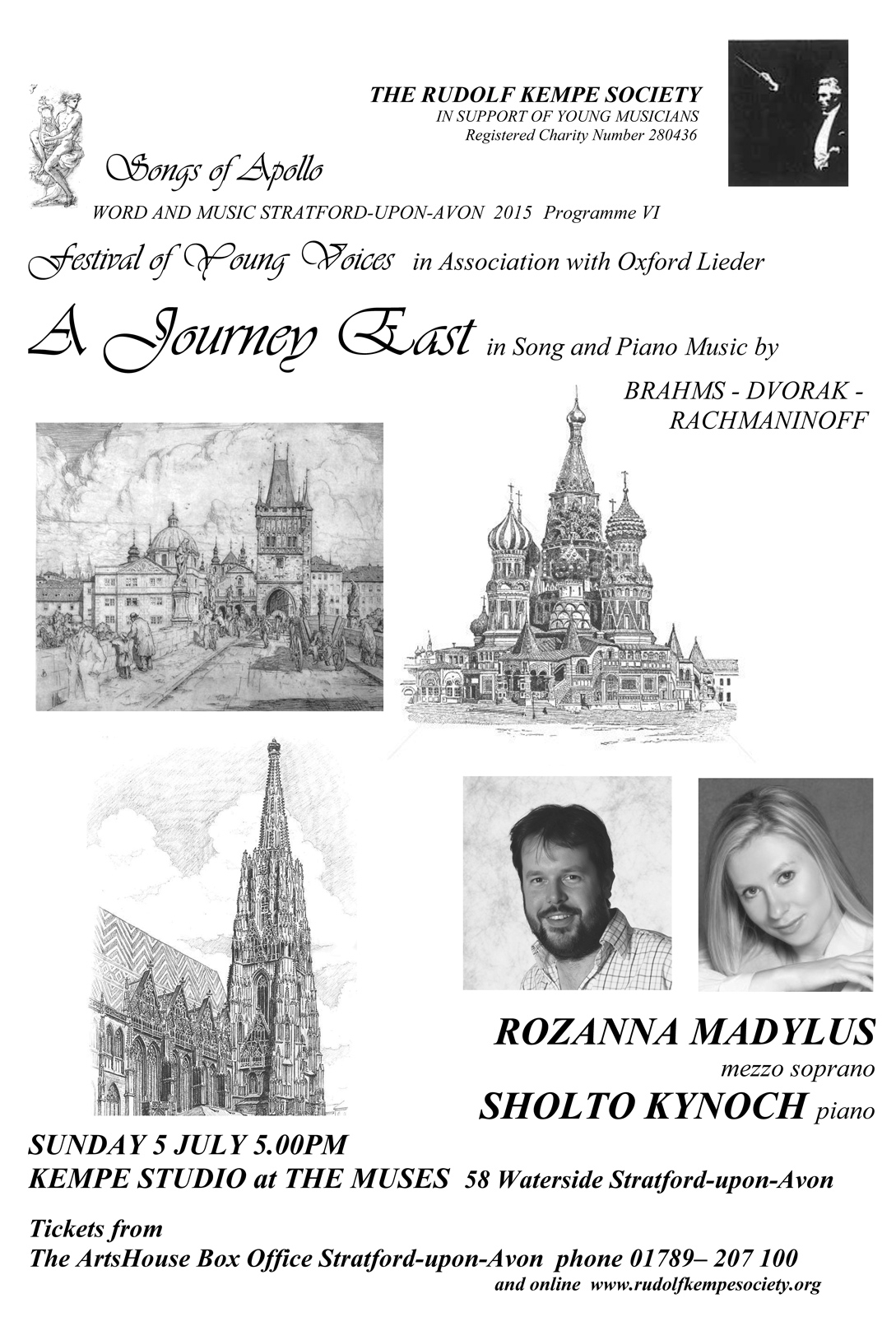
A Journey East in Song and Piano Music by Brahms, Dvořák and Rachmaninoff was Programme VI of the Rudolf Kempe Society’s 2015 Songs of Apollo season, a Festival of Young Voices concert given in association with Oxford Lieder. The mezzo-soprano Rozanna Madylus and the pianist Sholto Kynoch led a musical and literary journey across central Europe – setting out from Brahms’s Vienna, into Dvořák’s Bohemia and on to Rachmaninoff’s Russia – on Sunday 5 July 2015 at 5.00 pm at the Kempe Studio at The Muses, 58 Waterside, Stratford-upon-Avon. It was given in aid of the Rudolf Kempe Society International Young Artists Platform.
Performers
- Rozanna Madylus – mezzo-soprano. Born in Leicestershire of Ukrainian descent, she had just graduated from Royal Academy Opera and the Academy’s Song Circle, where she studied with Anne Howells and Jonathan Papp; she won a place on the Oxford Lieder Young Artist Platform in 2012 and the Karaviotis Prize at Les Azuriales in Nice. Her roles included Handel’s Ariodante and Ravel’s L’enfant et les sortilèges with the BBC Symphony Orchestra, and that summer she sang the Beggar Woman in Britten’s Death in Venice for Garsington Opera.
- Sholto Kynoch – piano. Founder and artistic director of Oxford Lieder and pianist of the Phoenix Piano Trio, he had just received the Royal Philharmonic Society Award for his work in song and chamber music, in particular the Oxford Lieder Schubert Project of 2014.
Programme
Part I – Setting out from Vienna
Johannes Brahms – from the 49 Deutsche Volkslieder, WoO 33 (anonymous poets)
- Guten Abend
- Die Sonne scheint nicht mehr
- Es steht ein Lind
- In stiller Nacht
Brahms – Von ewiger Liebe, Op. 43 No. 1 (after Hoffmann von Fallersleben) – Brahms’s own favourite song
Brahms – Seven Fantasias for piano, Op. 116
- Capriccio in D minor – Presto energico
- Intermezzo in A minor – Andante
- Capriccio in G minor – Allegro passionato
- Intermezzo in E major – Adagio
- Intermezzo in E minor – Andante con grazia ed intimissimo sentimento
- Intermezzo in E major – Andantino teneramente
- Capriccio in D minor – Allegro agitato
Interval
Part II – Into Bohemia and Russia
Antonín Dvořák – Love Songs (Cypresses) for voice and piano, Op. 83 (printed as Op. 88), after Gustav Pfleger-Moravský
- Ah, our love does not blossom
- In many a heart death dwells
- I linger by the house of my beloved
- I know, with sweet hope
- Over the landscape ruled by care-free dreams
- In the woods by the stream
- I would gladly, gladly perish
- Oh, you, my soul’s only dear one
Sergei Rachmaninoff – Songs
- Oh, never sing to me again!, Op. 4 No. 4 (Aleksandr Pushkin)
- I wait for thee!, Op. 14 No. 1 (Maria Davidova, after Paul Verlaine)
- Oh stay, my love, forsake me not!, Op. 4 No. 1 (Dmitry Merezhkovsky)
- When silent night does hold me, Op. 4 No. 3 (Afanasy Fet)
- Oh do not grieve!, Op. 14 No. 8 (Aleksey Apukhtin)
- As fair as day in blaze of noon, Op. 14 No. 9 (Nikolai Minsky)
About the programme
Dame Judi Dench, the Society’s patron, welcomed “another programme of delightful songs, interwoven with lyrical piano music”, on a journey from Austria to Bohemia and into Russia with two young artists as guides.
The booklet followed each composer. Brahms, who as a gifted boy pianist had to play in the sailors’ taverns of Hamburg to support his family, was taken up at twenty by Robert and Clara Schumann; after Robert’s death he helped Clara bring up her children, and the two remained the closest of friends, “though never more”. His songs – many of them folk-song settings – are almost all about love, and mostly its loss; Von ewiger Liebe, often taken for a folk song, is pure Brahms, as is his famous Lullaby. For his last twenty-five years he lived at Karlsgasse 4 in Vienna, a bust of Beethoven looking down on him in his study.
In 1865 the 24-year-old Dvořák set Pfleger-Moravský’s love poems out of his love for his pupil Josefina Čermáková, who did not return it; he later married her sister Anna, happily, and when Josefina died he poured his grief into his Cello Concerto. The songs were published in their original form only twenty years later, and he also arranged them for string quartet as the Cypresses – “Think of a boy in love – that’s the whole content,” he told his publisher Simrock. Rachmaninoff, born near Novgorod in 1873 and one of the greatest pianists of all time, wrote his songs Opp. 4 and 14 in the early 1890s, revealing himself as one of the finest melodists among composers; like Brahms, he combined personal reserve with a generous nature. The booklet was illustrated with landscapes by the Russian painter Isaak Levitan.
Downloads
- Poster (PDF) PDF
The Rudolf Kempe Society closed in 2021. This page is kept as a record of a past event.