- Date
- Time
- 7.30 pm
- Venue
- Studio at The Muses, 58 Waterside, Stratford-upon-Avon, Warwickshire
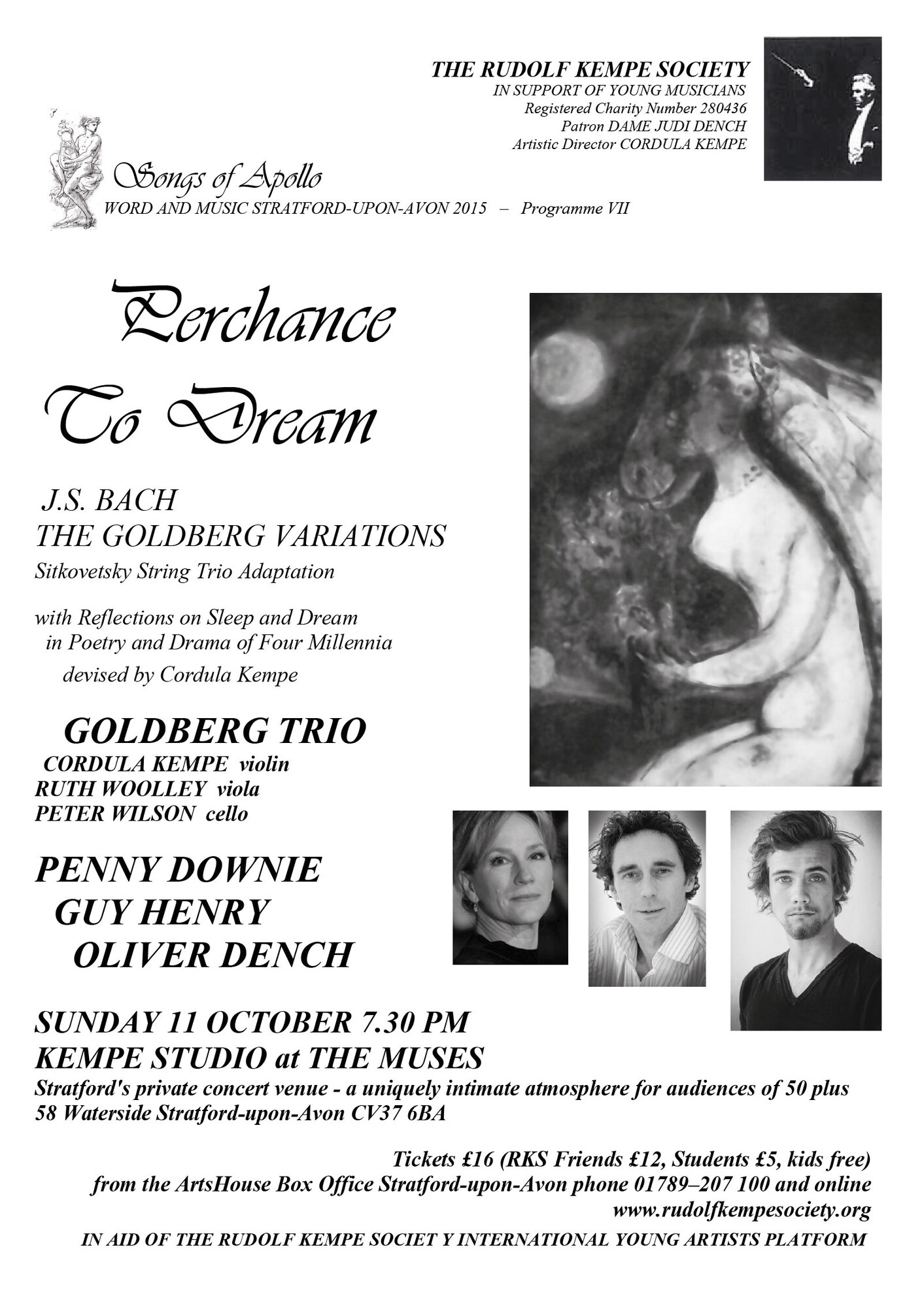
Perchance to Dream was Programme VII of the Rudolf Kempe Society’s 2015 Songs of Apollo season of word and music in Stratford-upon-Avon. Devised by Cordula Kempe, it set J. S. Bach’s Goldberg Variations, in Dmitry Sitkovetsky’s adaptation for string trio, among reflections on sleep and dream in drama and poetry of four millennia. It was performed on Sunday 11 October 2015 at 7.30 pm at the Kempe Studio at The Muses, 58 Waterside, Stratford-upon-Avon, in aid of the Rudolf Kempe Society International Young Artists Platform.
In her welcome in the programme book, the Society’s Patron, Dame Judi Dench, recalled that this was one of the last programmes her late brother Jeffery Dench – the Society’s Chairman – had performed with Cordula Kempe and her musicians, and quoted his favourite line, by Schiller: “Freedom lives only in the land of dreams, and beauty cannot live except in song.”
Performers
The Goldberg Trio (also billed as the Illyrian Trio), members of the Bergonzi String Quartet:
- Cordula Kempe – violin. Trained at the Munich State Academy and for 25 years a close colleague and assistant of Max Rostal, she played in Karl Richter’s Munich Bach Orchestra and the Munich Philharmonic, in the Kempe Trio with her husband Rudolf Kempe, and led the Bergonzi Quartet. She taught at the Richard Strauss Conservatoire in Munich and devised the Society’s word and music programmes.
- Ruth Woolley – viola. A Birmingham Conservatoire graduate who took part in the CBSO and Birmingham Royal Ballet Sinfonia training schemes, she was a core player of the Orchestra of the Swan and a founder member of the Bantock String Quartet, and won the Sylvia Cleaver, Herbert Lumby and Ambache prizes.
- Peter Wilson – cello. Yorkshire-born, he studied with Anna Shuttleworth and Leonid Gorokhov at the Royal College of Music, played for many Royal Shakespeare Company productions, recorded solo cello for film, radio and television, and was about to join the Singapore Symphony Orchestra.
Readers
- Penny Downie – an RSC Associate Artist whose roles there ranged from The Merchant of Venice (Globe Classic Award) to Queen Gertrude in Hamlet; Olivier-nominated, and known on screen from Downton Abbey, New Tricks and Inspector Morse.
- Guy Henry – an RSC actor of many Shakespearean roles, including King John, Malvolio and Parolles, Olivier-nominated for Ananias in The Alchemist, with National Theatre work and long-running television roles including Holby City.
- Oliver Dench – a member of the Society’s International Young Artists Platform 2014–15, who had made his RSC debut in The Witch of Edmonton and read in earlier Songs of Apollo programmes, including Music for a While in memory of his grandfather Jeffery Dench.
Programme
Johann Sebastian Bach – The Goldberg Variations, BWV 988, in the string trio adaptation by Dmitry Sitkovetsky, interwoven with readings.
Part I
- Friedrich von Schiller – Prologue: The Partition of the Earth; Poetry – Dream – Song from “The Beginning of a New Century”
- Anna Magdalena Bach – diary note, 1722
- Aria
- Johann Nikolaus Forkel and others – historical notes
- Variation 1 – Reiner Kunze: The Young Interpreter; Cordula Kempe: more historical notes; Edward Young: from Night Thoughts on Life, Death and Immortality
- Variation 2 – Lord Byron: from The Dream
- Variation 3 (Canone all’unisono) – Sigmund Freud and others: definitions of dream
- Variation 4 – John Ruskin and others: personal dreams
- Variations 5 and 6 (Canone alla seconda) – William Shakespeare: Sonnet 43
- Variation 7 (al tempo di giga) – John Donne: The Dream; Heinrich Heine: I wept in my dream; a Tamil poetess of the 2nd century AD: My Lover; Veronica Franco (16th-century Italy): Martyrdom
- Variation 8 – Hwang Chin-i (16th-century Korea): Cut in two; Seamus Heaney: Glanmore Sonnet X
- Variation 9 (Canone alla terza) – Shakespeare: from A Midsummer Night’s Dream, Act IV Scene 1
- Variation 10 (Fughetta) – Shakespeare: from Romeo and Juliet, Act I Scene 4
- Variation 11 – W. S. Gilbert: from Iolanthe
- Variation 12 (Canone alla quarta) – Heine: The Lonely Pine Tree; Derek Walcott: Midsummer, Tobago; Emily Dickinson: Wild Nights; Doris Lessing: from The Golden Notebook; the Bible: Song of Songs 5:5–8
- Variation 13 – John Keats: from Endymion
- Variation 14 – Mary Shelley: from her journal, 19 March 1815; the Bible: Job 7:13–15
- Variation 15 (Canone alla quinta, Andante) – Shakespeare: from Hamlet, Act III Scene 1
Interval
Part II
- Variation 16 (Ouverture) – Shakespeare: from Antony and Cleopatra, Act V Scene 2; Friedrich Hölderlin: Human Applause; Suetonius: from The Twelve Caesars; Ben Okri: Stammerings on Bedrock
- Variations 17 and 18 (Canone alla sesta) – Shakespeare: from Macbeth, Act V Scene 1
- Variation 19 – Queen Elizabeth I: Written on Her Window at Woodstock and Written on a Wall at Woodstock
- Variation 20 – Frank McGuinness: from Someone Who’ll Watch Over Me; the Broido family: Jewish Nightmares
- Variation 21 (Canone alla settima) – an anonymous 13th-century French poet: The Young Girl; M. G. Lewis: from The Monk (1796)
- Variation 22 – McGuinness: from Someone Who’ll Watch Over Me
- Variation 23 – Ben Okri: We Sing Absurdities; McGuinness: from Someone Who’ll Watch Over Me
- Variation 24 (Canone all’ottava) – Nadezhda Mandelstam: from Hope Abandoned (1938)
- Variation 25 (Adagio) – Ralph Giordano: from The Bertinis
- Variation 26 – Ben Okri: They Say and I Held You In The Square
- Variations 27 (Canone alla nona) and 28 – McGuinness: from Someone Who’ll Watch Over Me
- Variations 29 and 30 (Quodlibet) – Shakespeare: from The Tempest, Act IV Scene 1
- Aria da capo – John Donne: Epilogue; Shakespeare: Another Epilogue
About the programme
In her programme note, Cordula Kempe told the story of the work: Bach based it on a little aria he had written in 1722 in a notebook for his wife Anna Magdalena, and later wrote the variations for Count Keyserlingk, the Russian envoy at the Dresden court, who wanted music to ease his sleepless nights. They took their name from the Count’s protégé Johann Gottlieb Goldberg, a young pupil of Bach who played them to him. She explained how Sitkovetsky’s string trio version – he grew up hearing his mother, the pianist Bella Davidovich, play “the Goldbergs” – lets sustained string tone reveal Bach’s voice-leading and harmonies as no keyboard can, “a revelatory experience, especially in the slow movements”.
The readings about sleep, dreams, insomnia and its causes were set among the variations “in a blend of jovial mirth and solemnity”, reflecting Bach’s own wish that the music should “delight the soul”. The booklet also gathered thoughts on the Goldberg Variations from Angela Hewitt, Glenn Gould, Murray Perahia, Wanda Landowska and Bach’s first biographer Forkel, and ended Cordula Kempe’s own reflection with Prospero’s words: “our little life is rounded with a sleep.”
Credits
- Devised by Cordula Kempe, who also wrote the programme notes
- Patron: Dame Judi Dench
- Publicity and printing: Max Ross
Downloads
- Poster (PDF) PDF
The Rudolf Kempe Society closed in 2021. This page is kept as a record of a past event.