- Date
- Time
- 5 pm
- Venue
- Studio at The Muses, 58 Waterside, Stratford-upon-Avon, Warwickshire
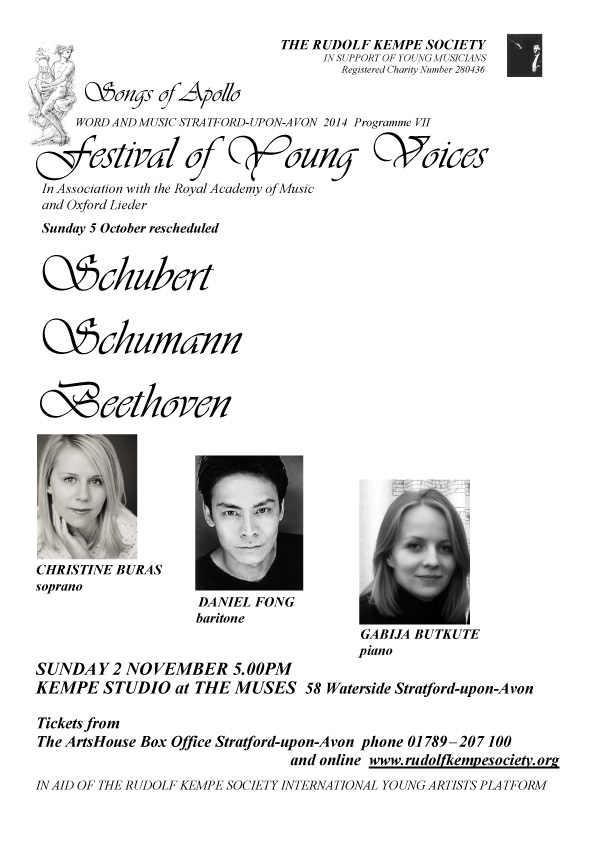
A Celebration of Songs by Schumann, Schubert and Beethoven was the second concert of the Society’s Festival of Young Voices – Programme VII of the 2014 Songs of Apollo season – given in association with the Royal Academy of Music and Oxford Lieder and supported by The Kohn Foundation. Three young artists of the RKS International Young Artists Platform 2014 sang Lieder by Schumann, Schubert and Beethoven. Originally planned for Sunday 5 October, the concert took place on Sunday 2 November 2014 at 5.00 pm at the Kempe Studio at The Muses, 58 Waterside, Stratford-upon-Avon. It was given in aid of the Rudolf Kempe Society International Young Artists Platform.
Performers
- Christine Buras – soprano (RKS International Young Artists Platform 2014). An American soprano who began as a chorister at Washington National Cathedral, she studied at the University of Chicago and Indiana University’s Jacobs School of Music before the postgraduate Vocal Studies course at the Royal Academy of Music. Her repertoire ranged from early music and oratorio to opera and new music.
- Daniel Fong – baritone (RKS International Young Artists Platform 2014). A Master’s student at the Royal Academy of Music and member of its Song Circle, he won the Marjorie Thomas Song Competition in 2014 and had taken part in master classes with Simon Keenlyside, Joan Rodgers, Helmut Deutsch and others, and at the Oxford Lieder Festival.
- Gabija Butkute – piano (RKS International Young Artists Platform 2014). Born in Vilnius and a graduate of the Lithuanian Academy of Music and Theatre, she was studying piano accompaniment with Michael Dussek and Andrew West at the Royal Academy of Music. Her prizes included the Ludmilla Andrew Prize for Russian Song and the Marjorie Thomas Art of Song Prize (2013).
Programme
Part I
Robert Schumann – from Liederalbum für die Jugend, Op. 79
- Frühlingsgruß (Spring Greeting) – Hoffmann von Fallersleben
- Zigeunerliedchen I and II (Gypsy Songs) – Emanuel Geibel
- Der Sandmann (The Sandman) – Hermann Kletke
- Marienwürmchen (Ladybird) – Karoline Rudolphi
- Schneeglöckchen (Snowdrop) – Friedrich Rückert
- Mignon – Johann Wolfgang von Goethe
Franz Schubert
- Der Schiffer (The Boatman) – Johann Mayrhofer
- Der Schiffer (The Boatman) – Friedrich von Schlegel
- Der Wanderer (The Wanderer) – Schmidt von Lübeck
- Der Wanderer (The Wanderer) – Friedrich von Schlegel
- Heimliches Lieben (Secret Love) – Karoline Louise von Klenke
- Geheimes (A Secret) – Goethe
- Der Wanderer an den Mond (The Wanderer Addresses the Moon) – Johann Gabriel Seidl
Ludwig van Beethoven – Six Songs, Op. 48 (Christian Fürchtegott Gellert)
- Bitten (Supplication)
- Die Liebe des Nächsten (Love of One’s Neighbour)
- Vom Tode (Of Death)
- Die Ehre Gottes in der Natur (The Glory of God in Nature)
- Gottes Macht und Vorsehung (God’s Might and Providence)
- Bußlied (Song of Atonement)
Interval
Part II
Franz Schubert
- Nachtviolen (Dame’s Violets) – Johann Mayrhofer
- Sehnsucht (Longing) – Mayrhofer
- Sehnsucht (Longing) – Johann Gabriel Seidl
- Sehnsucht (Longing) – Friedrich von Schiller
- Sonett 1 and Sonett 2 – August Wilhelm von Schlegel, after Petrarch
- Wiedersehen (Reunion) – August Wilhelm von Schlegel
- Liebe schwärmt auf allen Wegen (Claudine’s Arietta) – Goethe
Robert Schumann – Frauenliebe und -leben (A Woman’s Love and Life), Op. 42 (Adelbert von Chamisso)
- Seit ich ihn gesehen
- Er, der Herrlichste von allen
- Ich kann’s nicht fassen, nicht glauben
- Du Ring an meinem Finger
- Helft mir, ihr Schwestern
- Süßer Freund, du blickest mich verwundert an
- An meinem Herzen, an meiner Brust
- Nun hast du mir den ersten Schmerz getan
About the programme
Cordula Kempe’s programme notes set the three composers side by side. Beethoven, the giant of instrumental music, also had a private, intimate side expressed in his Lieder – still rarely heard in concert – which reveal his longing for love, his wit and above all his spirituality; his six Gellert songs, Op. 48, she wrote, leave no doubt where he stood, more directly than any of his mass settings. Schubert, by contrast, won no fame in his short life: many of his greatest works were neither performed nor published until long after his death, and his songs – six or seven hundred of them – opened up in music “the vastness of the universe” and the loneliness of the individual in it.
Schumann wrote most of his songs for his wife, the pianist Clara Wieck, including Frauenliebe und -leben from 1840, his “Year of Song”. The booklet set Vienna, where Beethoven and Schubert wrote all the songs of the programme, beside Leipzig, the city of Bach and of Schumann. The Society’s patron, Dame Judi Dench, welcomed the evening as a celebration of the Lied, “the most sublime union of the two kindred arts of poetry and music”.
Credits
- Programme devised by Cordula Kempe; translations of the German texts and advice by Professor Richard Stokes
- In association with the Royal Academy of Music and Oxford Lieder
- Supported by The Kohn Foundation
Downloads
- Poster (PDF) PDF
The Rudolf Kempe Society closed in 2021. This page is kept as a record of a past event.