- Date
- Time
- 7.30 pm
- Venue
- Studio at The Muses, 58 Waterside, Stratford-upon-Avon, Warwickshire
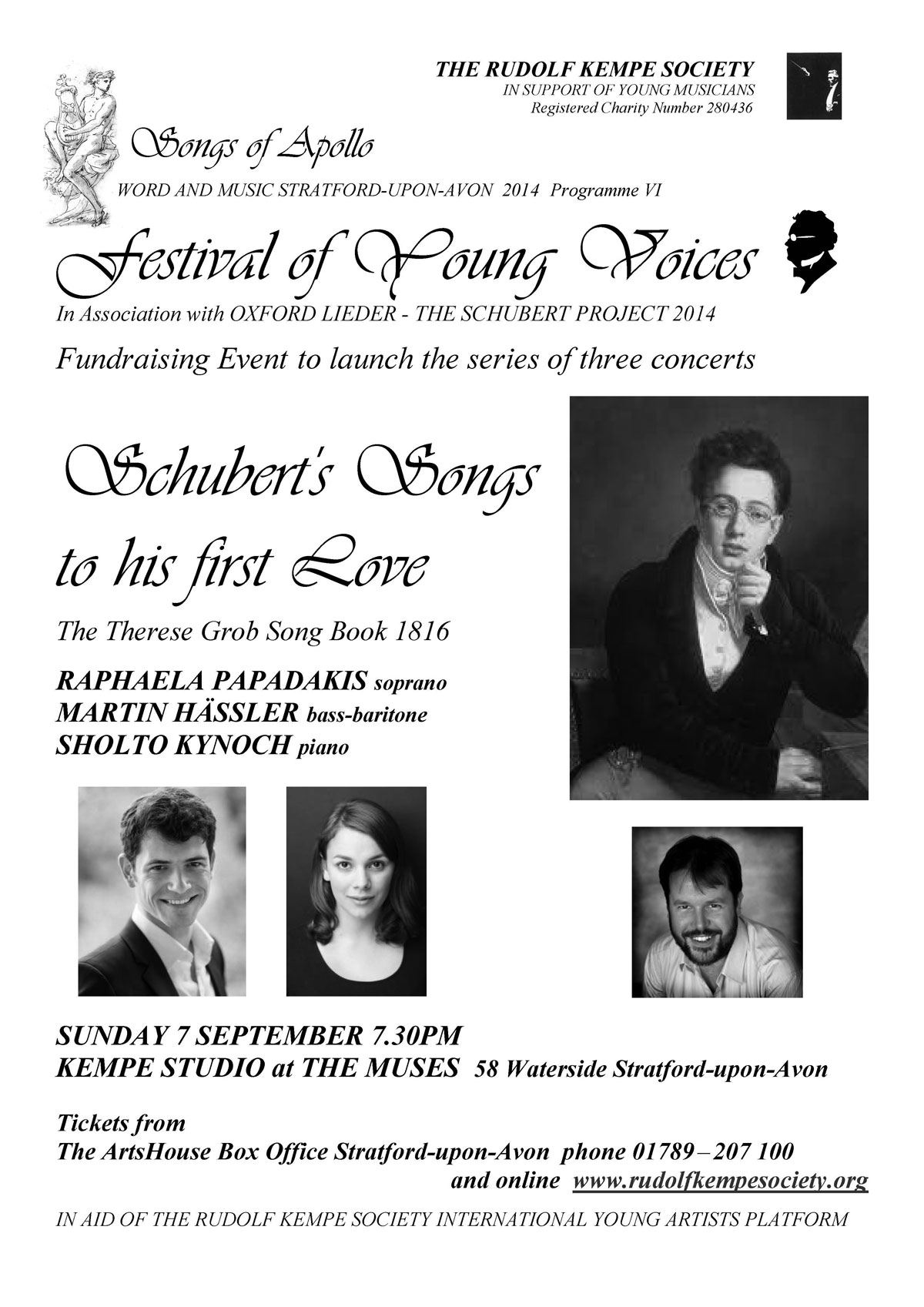
Schubert’s Songs to his First Love – the songbook of 1816 that Franz Schubert dedicated to Therese Grob, with a selection of later songs – was Programme VI of the Rudolf Kempe Society’s 2014 Songs of Apollo season and part of its Festival of Young Voices. It was given in association with Oxford Lieder and its Schubert Project 2014 on Sunday 7 September 2014 at 7.30 pm at the Kempe Studio at The Muses, 58 Waterside, Stratford-upon-Avon.
The evening was a fundraising concert to launch a series of three Oxford Lieder Schubert Project concerts at The Muses (the others followed on 5 October and 2 November 2014), given with the Society’s International Young Artists Platform. The artists gave their fees to the common cause of Lieder and young artists.
Performers
- Raphaela Papadakis – soprano (RKS International Young Artists Platform 2014). A London-born soprano and Cambridge English graduate, she was studying for an Artist Diploma at the Guildhall School of Music & Drama with Janice Chapman, had made her Garsington Opera début, and had sung Schubert for Oxford Lieder, recording a selection of his songs with Sholto Kynoch. Her prizes included the Clonter Opera and Maureen Lehane awards.
- Martin Hässler – baritone / bass (RKS International Young Artists Platform 2014). Born in 1989, he trained at the Leipzig Hochschule für Musik and then at the Guildhall School with Rudolf Piernay, worked with Dietrich Fischer-Dieskau in 2011, and made his Wigmore Hall recital début in 2013. He won second prize in Thomas Quasthoff’s Das Lied competition and the Best Singer’s Award at the Gerald Moore Competition.
- Sholto Kynoch – piano. Founder and director of the Oxford Lieder Festival and pianist of the Phoenix Piano Trio, he was recording the complete songs of Hugo Wolf live at the festival. He studied at Worcester College, Oxford, the Royal Academy of Music and the Guildhall School, and is an Associate of the Royal Academy of Music.
Programme
Part I – Selected songs
- Schubert – An die Leier, D 737 (Franz von Bruchmann, after Anacreon; 1822 or 1823)
- Schubert – Gesänge des Harfners, D 478 (Johann Wolfgang von Goethe, from Wilhelm Meister; second version, 1822):
- Wer sich der Einsamkeit ergibt
- Wer nie sein Brot mit Tränen aß
- An die Türen will ich schleichen
Interval
Part II – The Song Book for Therese Grob
- Edone, D 445 (Friedrich Gottlieb Klopstock; June 1816)
- Andenken, D 99 (Friedrich von Matthisson; April 1814)
- An die Natur, D 372 (Friedrich Leopold Graf zu Stolberg; 15 January 1816)
- Pflügerlied, D 392 (Johann Gaudenz von Salis-Seewis; March 1816)
- Der Leidende (Klage), D 432 (anonymous, attributed to Ludwig Hölty; May 1816)
- Lied, D 403 (Salis-Seewis; 27 March 1816)
- Der Herbstabend, D 405 (Salis-Seewis; April 1816)
- Am Grabe Anselmos, D 504 (Matthias Claudius; November 1816)
- Klage an den Mond, D 436 (Ludwig Hölty; 12 May 1816)
- Lied aus der Ferne, D 107 (Matthisson; July 1814)
- Zufriedenheit (Lied), D 501 (Claudius; November 1816)
- Am ersten Maimorgen, D 344 (Claudius; 1816?)
- Mailied, D 503 (Hölty; November 1816)
- Trauer der Liebe, D 465 (Johann Georg Jacobi; August 1816)
- Litanei auf das Fest Allerseelen, D 343 (Jacobi; August 1816)
- Gott im Frühlinge, D 448 (Johann Peter Uz; June 1816)
About the programme
Therese Grob was a schoolmaster’s daughter from Schubert’s neighbourhood in Vienna, whom he befriended at seventeen and who sang the soprano solo in his Mass in F of 1814. She was most likely the one love of his life: he hoped for three years to marry her but could not find a post that would keep them both, and she later married a master baker. Many of the songs he wrote from 1814 onwards are love songs, and the book he dedicated to her was probably compiled in November 1816.
In her introduction, The Unfinished Genius, Cordula Kempe described a composer who died at thirty-one leaving more works than any other major composer – many unperformed and unpublished, much of it lost – and who opened up in music “the vastness of the universe” and the loneliness of the individual within it, constantly shifting between light and shade. She closed with Schubert’s own diary note: “I wanted to sing of love, but it turned into pain. I wanted to sing of pain, and it turned into love.”
Sholto Kynoch introduced Oxford Lieder’s Schubert Project 2014, which offered the complete songs of Schubert performed by leading interpreters alongside new talent, and welcomed the start of a “neighbourly” musical partnership with the Kempe Studio at The Muses. The Society’s patron, Dame Judi Dench, welcomed the evening as a celebration of the Lied, “the most sublime union of the two kindred arts of poetry and music”.
Credits
- Programme written and designed by Cordula Kempe, produced by Max Ross
- In association with Oxford Lieder (artistic director Sholto Kynoch)
- The Kohn Foundation supported the Rudolf Kempe Society International Young Artists Platform
Downloads
- Poster (PDF) PDF
The Rudolf Kempe Society closed in 2021. This page is kept as a record of a past event.