- Date
- Time
- 7.30 pm
- Venue
- Studio at The Muses, 58 Waterside, Stratford-upon-Avon, Warwickshire
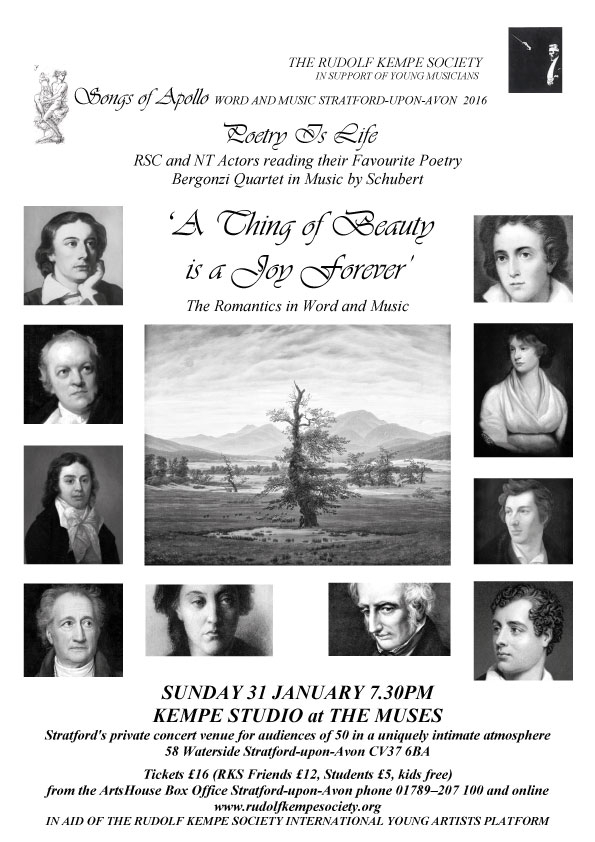
Poetry Is Life – the Rudolf Kempe Society’s annual “poetry marathon” of actors reading their favourite poems – reached its tenth year in 2016. Programme I of that year’s Songs of Apollo season, A Thing of Beauty Is a Joy for Ever – The Romantics in Word and Music was devised by Cordula Kempe and given on Sunday 31 January 2016 at 7.30 pm at the Kempe Studio at The Muses, 58 Waterside, Stratford-upon-Avon. Seven actors and a young reader from the Society’s Young Artists Platform read poetry by Keats, Shelley, Wordsworth, Blake, Byron, Heine and their contemporaries, between dances, minuets and quartet movements by Schubert played by the Bergonzi Quartet and Zubin Varla at the piano. It was given in aid of the Rudolf Kempe Society International Young Artists Platform.
Performers
Readers
- Clifford Rose – Honorary Associate Artist of the Royal Shakespeare Company
- Nicholas Day
- Sam Dastor
- Karen Drury
- Jennifer McEvoy
- Sonia Ritter
- Zubin Varla
- Thomas Aminfar-Antoniw – RKS Young Artists Platform
Bergonzi Quartet
- Cordula Kempe – violin. Trained at the Munich State Academy and for 25 years with Max Rostal, whose assistant she became; she played in Karl Richter’s Munich Bach Orchestra and the Munich Philharmonic, in the Kempe Trio with her husband Rudolf Kempe, and led the Bergonzi Quartet. She had recently retired from teaching at the Richard Strauss Conservatoire in Munich.
- Barbara O’Reilly – violin. Studied at the University of Birmingham and the Royal Northern College of Music; a member of the Longborough Opera orchestra who also played with the CBSO and taught in Warwickshire and Coventry schools.
- Robin Del Mar – viola. Son of the conductor Norman Del Mar; he played in the Royal Philharmonic Orchestra under Rudolf Kempe and Leopold Stokowski, later co-principal, and was second principal viola of the BBC Concert Orchestra.
- Jenny Curtis – cello. Studied at the Royal Northern College of Music, where she later taught for eleven years; formerly of the Philharmonia, she stood in for the quartet’s long-standing cellist Peter Wilson, who had emigrated.
Piano
- Zubin Varla – piano. Known as an actor with the RSC, the National Theatre and in the West End, he also trained at the Guildhall School as a pianist and singer, and had worked with Cordula Kempe on word and music programmes since 1994.
Programme
Music by Franz Schubert: Minuets and German Dances for string quartet, D 86 and D 89; String Quartet in E flat major, D 87; German Dances, Op. 33, and Moments musicaux, Op. 94, for piano. Readers are shown in brackets; * marks Cordula Kempe’s own translations or contributions.
Part I
- Schubert – Minuet, D 86, for string quartet
- Introduction: The Romantics – the historical situation (ensemble)
- Heine – Iron helmets * (Sam Dastor)
- Poetry Is Life (ensemble)
- Jim Burns – Against the Romantics * (Sonia Ritter)
- Schubert – German Dance in A minor, Op. 33 No. 10, for piano
- Against ‘Against’ (ensemble)
- Shelley – from The Mask of Anarchy (Zubin Varla)
- Schubert – German Dance in A major, Op. 33 No. 1
Nature
- Keats – from Endymion, Book I: A Thing of Beauty is a Joy for Ever (Clifford Rose)
- Schubert – String Quartet in E flat major, D 87: 1. Allegro moderato
- Wordsworth – The Daffodils (Jennifer McEvoy)
- Schubert – German Dance in D major, Op. 33 No. 2
- Wordsworth – The Rainbow (Nicholas Day)
- Shelley – Ode to the West Wind (Karen Drury)
- Keats – To one who has been long in city pent (Sam Dastor)
- Schubert – German Dance in D major, Op. 33 No. 15
- Thomas Hardy – We Field-Women (Sonia Ritter)
- Schubert – German Dance in B flat major, Op. 33 No. 7
Love
- Goethe – Love * (Karen Drury)
- Byron – She Walks in Beauty (Thomas Aminfar-Antoniw)
- Heine – I do not know * (Sam Dastor)
- Schubert – String Quartet D 87: 2. Scherzo and Trio
- Keats – La Belle Dame sans Merci (Jennifer McEvoy)
- Heine – Tears * (Sam Dastor)
- Schubert – D 87: Scherzo repeated
- Heine – I can’t forget I had you * (Nicholas Day)
- Elizabeth Barrett Browning – How do I love thee? (Jennifer McEvoy)
- Schubert – D 87: 3. Adagio
- Keats – His Last Sonnet (Clifford Rose)
- Schubert – German Dance in B minor, Op. 33 No. 5
- Heine – Oh, they loved dearly * (Sam Dastor)
- Leigh Hunt – Jenny Kissed Me * (Thomas Aminfar-Antoniw)
- Heine – Kisses * (Sam Dastor)
- Schubert – D 87: 4. Allegro
- Jim Burns – Epitaph in case it should happen * (Zubin Varla)
Interval
Part II
- Schubert – Minuet, D 89 No. 1, for strings, with Trios I and II
Poetry in Nature
- Keats – letters of 1817: “Negative Capability”, Beauty and Truth (ensemble)
- Schubert – German Dance, D 89 No. 1, Trio II
- Healing (ensemble)
- Hardy – The Darkling Thrush (Clifford Rose)
- Schubert – Moment musical in A flat major, Op. 94 No. 2
- Schubert – Diary note * (Zubin Varla)
- Schubert – German Dance in B flat major, Op. 33 No. 3
- Keats – Ode to a Nightingale (Nicholas Day)
- Schubert – Minuet, D 89 No. 3, with Trio I
- Blake – The Fly * (Zubin Varla)
- Schubert – Minuet, D 89 No. 5, with Trio I
A Different Kind of Love
- Blake – The Clod and the Pebble * (Karen Drury)
- Schubert – German Dance in F minor, Op. 33 No. 14
- Blake – The Garden of Love * (Zubin Varla)
- Heine – a quotation * (Sam Dastor)
- Schubert – from Minuet, D 89 No. 3, Trio II
- Leigh Hunt – Abou Ben Adhem (Sam Dastor)
- Schubert – German Dance, D 89 No. 2, with Trios I and II
Forgiveness
- Heine – Forgiving your enemies * (Nicholas Day)
- Blake – A Poison Tree * (Zubin Varla)
- Heine – God’s Forgiveness * (Nicholas Day)
- Schubert – from German Dance, D 89 No. 3, Trio
- Wordsworth – Intimations of Immortality (Sam Dastor)
- Schubert – from Minuet, D 89 No. 3, Trio II
Misery and Compassion
- Goethe – The Harpist’s Song * (Karen Drury)
- Keats – Ode on Melancholy (Sonia Ritter)
- Schubert – Moment musical in F minor, Op. 94 No. 3, D 780
- Schubert – Diary note, 1824 * (Zubin Varla)
- Shelley – Invocation to Misery * (Thomas Aminfar-Antoniw)
- Schubert – Diary note * (Zubin Varla)
- Schubert – from German Dance, D 89 No. 5, Trios and Coda
- David Bowie – Love Song (Nicholas Day)
Epilogue
- Oscar Wilde – On the Sale by Auction of Keats’ Love Letters * (Clifford Rose)
- Emily Brontë – Last Lines (Karen Drury)
- Schubert – Moment musical in A flat major, Op. 94 No. 2
About the programme
The title is the opening line of John Keats’s Endymion; the series takes its name from the words of an anonymous 20th-century Russian writer, printed in the booklet: “Poetry does not exist to make life beautiful. Poetry is Life itself.” In her introduction (January 2016), Cordula Kempe presented the English Romantics – Keats, Shelley, Byron, Wordsworth and their circle – and their contemporaries on the continent as heirs both of the Enlightenment and of the French Revolution’s aftermath: politically engaged writers, some of whom were imprisoned for their beliefs, whose poetry of nature and love was not an escape but a source of healing.
She explained that the music was mostly dances, the oldest form of human expression and the common language of the age, and that Schubert’s light-hearted dances never lose their undercurrent of sadness – as in his own words: “I wanted to sing of love, but it turned into pain. I wanted to sing of pain, and it turned into love.” The booklet also printed Schubert’s diary notes of March 1824 and a welcome from the Society’s patron, Dame Judi Dench, to the tenth Poetry Marathon.
Credits
- Devised by Cordula Kempe
- The actors gave their services; publicity and printing were supported by Max Ross
- Patron: Dame Judi Dench
Downloads
- Poster (PDF) PDF
The Rudolf Kempe Society closed in 2021. This page is kept as a record of a past event.